Parish Responsibilities
The PCC must ensure that there is always a Parish Safeguarding Officer (PSO) and a Disclosure Officer (DO); both roles are appointed by the PCC. The PSO is the key link between the diocese and a parish – view the PSO role description. The DO only holds responsibility for processing, obtaining and storing DBS checks for their parish.
All parishes must ensure they are aligned with the Safer Recruitment Policy. Duties of this include, but are not limited to:
- Disclosure and Barring Service (DBS) checks for volunteers and employees.
- Ensuring all church officers have undertaken the appropriate level of Safeguarding Training for their role.
- Only making a final appointment of position once all pre-appointment checks are complete.
Safer Recruitment Policy
All parishes should be aligned with the Safer Recruitment Policy that was implemented in 2022. Significant changes this policy brought about can be found below:
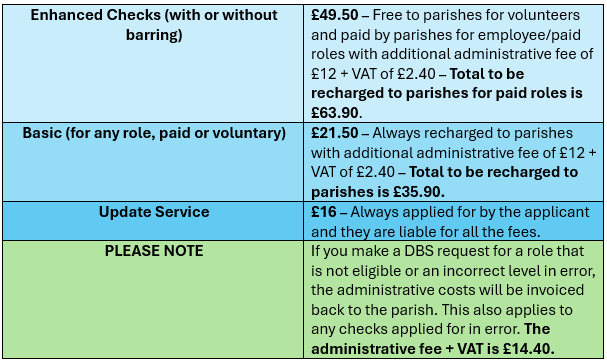
- DBS checks to be undertaken every three years. This is a change from the previous renewal timeframe of five years. DBS checks undertaken from 2019 onwards should have the new timescales applied to them and you will need to review your records at parish level to ensure that you are fully compliant with the three-yearly renewals by the end of 2023. Please see Section 9 of the Church of England guidance for further information.
- A Confidential Declaration must be completed for any roles that have contact with children and vulnerable adults, and are subject to an Enhanced DBS check. Please see Section 5 of the Church of England guidance for more information.
- Whilst having hard copies can be easier to use, please note that hard copies will not be issued. Any updates will come out on the Church of England Safeguarding E-Manual.
Safer Recruitment and People Management FAQs can be found on the Church of England website.
Disclosure and Barring Service (DBS)
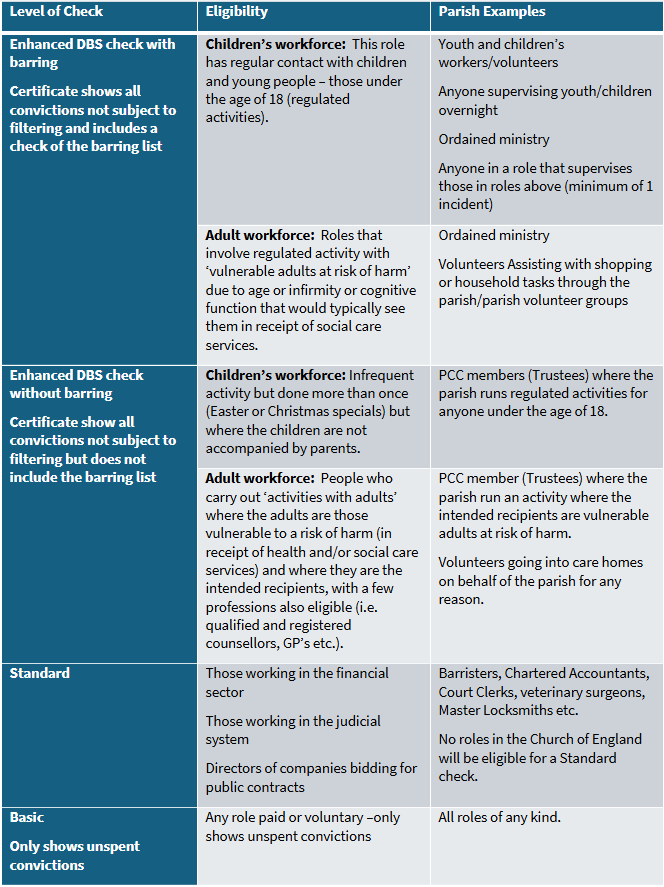
The PCC and incumbent are responsible for ensuring that all paid or volunteer workers with children, young people, and vulnerable adults at risk are safely recruited, trained, supported, and supervised. DBS checks, where a role is eligible, form one part of this safer recruitment process.
Failure to follow safer recruitment procedures may place children, young people, or vulnerable adults (as defined by the Care Act 2014) at risk. It may compromise parish insurance, harm the reputation of the wider Church, and constitute a breach of the Safeguarding (Code of Practice) Measure 2021.
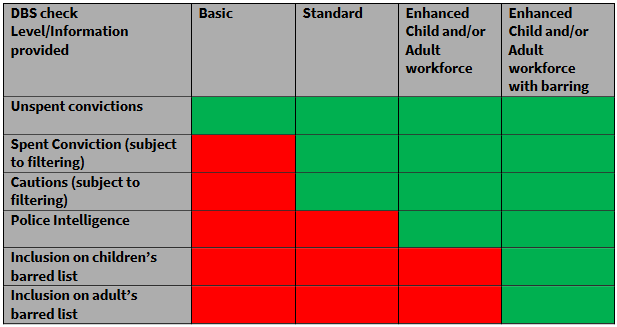
DBS checks are not a legal requirement in themselves; they are a safeguarding tool that may be used only when a role is eligible. Organisations have no automatic right to request any level of check. There are legal restrictions to protect individuals. Requesting a DBS check for a non-eligible role is an offence under the Rehabilitation of Offenders Act 1974, which could expose the organisation to criminal prosecution and fines.